Big Blue Expeditions
When Captain Jannek Olsson tries to recall his most memorable experience during his 17 years aboard the superyacht Octopus, he finds it impossible to settle on just one moment. The time spent exploring the ocean on this famous yacht has given him a wealth of wonderful memories, from witnessing the awesome splendour of Antarctica’s mighty icebergs up close to discovering sunken battleships in the Philippines. “There have been so many monumental trips,” he says.
Highlights of these trips, however, have included “seeing a polar bear for the first time, visiting the Northwest Passage, swimming with whale sharks in Indonesia, seeing underground volcanoes in the Sea of Cortez and looking for giant squid in Mexico,” says Jannek.
Such marvels can also be enjoyed by those who charter the Octopus, a yacht of visionary design and pioneering purpose. Octopus is the flagship vessel of Big Blue Expeditions, its ownership company, which is committed to providing a unique combination of luxury and adventure. Launched in 2003, the yacht has a storied history; it was conceived by, and built for, Microsoft co-founder Paul Allen, who wanted a vessel capable of reaching the wildest and most remote parts of the planet while providing outstanding comfort and privacy. Big Blue Expeditions maintains that legacy, adding Octopus to its portfolio, which includes The Resort Villa in Rayong, Thailand, and Ravenger, a high-performance luxury sailing yacht.
“We are seeing a crossover with people who have spent time on Octopus wanting to stay at the villa and vice versa,” says Jacqui Lockhart, Charter Manager at Big Blue Expeditions. “They have seen how things are managed and what we offer. Our properties all share a love for high standards and finding unique ways to bring people together in different locations to be looked after in total comfort.”
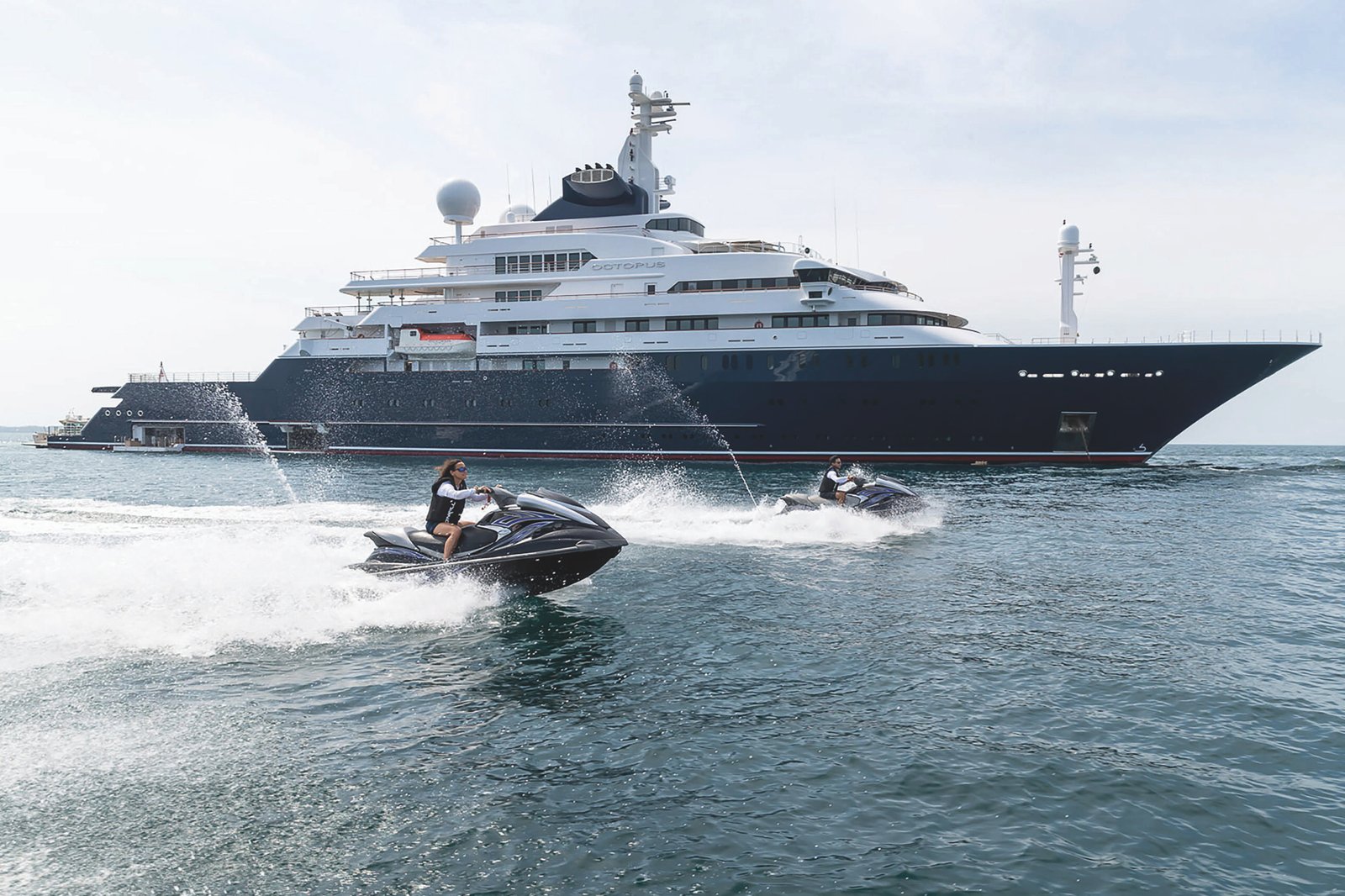
Octopus is the crown jewel. The 126-metre vessel was acquired by Big Blue Expeditions in 2021 after years spent sailing the world and hosts up to 12 guests and 50 crew, ensuring the highest levels of service in any location and in all weather conditions. She was designed by the prestigious, Monaco-based Espen Øino Naval Architects and built by the legendary shipyard Lürssen in Germany, with an interior by US superyacht designer Jonathan Quinn Barnett, all of whom were asked to stretch the limits of engineering and creativity.
With a range of up to 8,000 nautical miles, Octopus brings unprecedented style to transoceanic voyages. Among the extravagant touches are two helipads – one of which doubles as a basketball court – a helicopter hangar, an outdoor Jacuzzi and a seven-metre outdoor pool that converts into a dance floor. Guests also have the option to be entertained in the 15-seat private cinema, have a game of table tennis or relax with a book in the library. Luxurious wellness facilities encompass a gym, sauna, steam room and spa. As for dining, a team of professional chefs cater to any taste or dietary requirement from the well-stocked onboard stores – while other special requests can be flown in, if need be, with notice.
On the lowest deck, guests have access to an underwater observation lounge featuring a glass floor surrounded by sofas. Here, guests can gaze at the spotlit wonders in the ocean below in comfort. The room is complemented by the deck at the very top of the yacht, which provides breathtaking 180-degree views from a comfortable crow’s nest. In addition, the immense internal marina houses an ROV, or robotic submersible, and a 54ft motor yacht that can be launched from within Octopus herself.
The ROV is one of Octopus’s best water toys. It can descend to 3,000 metres and send back breathtaking images from the deepest, darkest depths of the sea. “When we are in Antarctica, we send the ROV down to the seabed while we are having dinner to see what is happening below us,” says Jannek. “You might see something that nobody else will ever see in their lifetime. We also use her to look at wrecks, which allows us to look out for any potential environmental issues such as oil spills. We try to mix good experiences with something valuable when we can.”
The indulgence of these public areas is mirrored by the opulence of the private spaces and accommodation. The master suite is a prime example. This spacious, deluxe cabin comes with a lounge area, study, private deck for dining, a bar, bathroom and Jacuzzi. There are 13 cabins in total, among which is a twin room with an adjoining bedroom for a nanny or tutor, which is perfect for travelling families. Like the rest of the yacht, the interiors exude a modern, luxurious feel, which is not only down to the current owner’s stewardship and renovations, but also the yacht’s original construction. “She is timeless in design and has been very well maintained,” says Jannek. “The interior is still very impressive and feels contemporary, which is a credit to the way the yacht was designed and built. They put in the money and effort right at the start and it has paid off.”
A unique feature of Octopus is the studio on the bridge deck. This was originally built as a state-of-the-art recording space, but was converted by Big Blue Expeditions into an entertainment area. It retains many of the distinctive features of the old studio space, such as the guitar racks and control room, which now acts as a DJ booth. A musical history echoes in the walls here – as a studio, it was used by musicians including U2, Mick Jagger and Dave Stewart.
As Jannek says, this is obviously no “run-of-the-mill” superyacht. Octopus was designed with two distinct and very different audiences in mind: VIP guests and scientists. Hence, it is uniquely equipped to meet seemingly impossible and contrasting demands. “There is a conflict between superyachting and exploration, because with superyachts everything needs to be perfect, first time, every time, while exploration is almost the exact opposite,” says Jannek. “People want VIP service, but they want to have adventures. Our role is to bring them together. We always get that right by trying to see how far our guests are prepared to go in search of fun.”
Because Octopus was commissioned with the specific intention of visiting remote areas, she was designed with exploration in mind. This can be felt most clearly in her sheer heft. “It’s like driving a limo instead of a sports car,” says Jannek. “She has a bit of weight to her which means you can handle all sorts of conditions. That gives you confidence when you take guests to Antarctica and meet 70-knot winds and eight-metre waves, because you need to sometimes go through these conditions to find the important places that provide special experiences.”
These rare treats include voyages to the Northwest Passage, a sea route through Canada’s Arctic Archipelago that few yachts of this class can handle, as well as island- hopping in the Pacific to find the most secluded and beautiful areas for diving. As this is a popular activity with guests, the yacht has two dedicated dive areas, complete with compression chamber and expert instruction so that even a novice can be a trained diver by the end of their stay. Once safely in the water, divers are guided to incredible locations to see marine life swimming among shipwrecks.
The crew always seek exciting new destinations to take their guests – a continuation of Octopus’s history as a research vessel. Microsoft’s Paul Allen, who commissioned Octopus, was committed to furthering human knowledge and used the yacht to make a series of historic discoveries on the seabed. This includes locating the bell of HMS Hood, sunk by the German battleship Bismarck in the Denmark Strait in 1941 and now in the Royal Navy’s museum in Portsmouth. Octopus was also used to find the mighty Japanese battleship Musashi, which was sunk in the Philippines during World War Two. Until it was found in 2015, the latter was one of the largest lost ships in the world. “We were the first people to see that on the seabed and that’s an unforgettable experience,” says Jannek. Octopus’s Musashi bar is named after this discovery.
Luckily for guests, Jannek is onboard to share his memories. He is one of several crew members to have served under both Allen and Big Blue Expeditions. This is testament to the appeal of Octopus – after her, there is simply nowhere better to go. Although maintaining a link with the yacht’s past is important to its new ownership, some changes have taken place. Aside from refurbishment, upgrades and maintenance, effort has been put into creating a more collegiate ambience. “It’s now more like a family, with a focus on making sure everybody onboard is comfortable,” says Jannek. “Yachts are amazing assets, but people bring them to life. That’s something we take very seriously. We want our crew to be happy because we know that will enhance the experience of the guests.”
Jacqui Lockhart, who has spent her career working in the superyacht industry, confirms that the team at Octopus is particularly special. “The level of service, attention and atmosphere on board is just incredible,” she says. “This is a team that as individuals have developed years of knowledge in different locations and on different yachts, who’ve now all come together.”
When a guest charters Octopus, they become part of its history. They often come onboard with knowledge of the yacht’s past adventures and a desire to perpetuate them. This is by no means essential, but for those prepared to indulge their imagination and lust for life, few places are off limits. “This is really the only yacht in this sector that does world cruising,” says Jacqui. “A handful have the capability, but they aren’t as adventurous. Within reason, we can relocate as and where there is demand and we are finding that the sort of clients that can afford this type of vessel are becoming more and more bold in the choices they make.”
For a while, Jannek marked his trips with Octopus using Google Earth and was amazed at the result: a line criss-crossing major oceans and small seas until almost every patch of blue had been covered. Octopus has spent several winters in Antarctica to see the untouched mass of ice and snow, and the vast continent is now a popular location for charter trips. Others prefer the rather different kind of beauty provided by the Pacific, the Mediterranean or the Baltic Sea. Every journey enables Jannek and his team to amass more information and ideas for future trips.
Big Blue Expeditions wants guests to feel completely integrated with the boat, having created an environment where they feel they are part of a team. While the crew are responsible for the day-to-day running of the yacht, the guests can involve themselves as much, or as little, as they desire. “If our guests are comfortable with us and with Octopus,” says Jannek, “they can explore all sorts of weird and wonderful places. We want them to try new things and give them experiences they can’t find anywhere else.”
Jannek and Jacqui both share the attitude that being part of the Octopus story is a privilege. They talk about the yacht with love and respect. Jacqui reflects on the importance of respect – for the crew and guests, for the ocean and for Octopus herself – while Jannek says that the unforgettable experience of working on the yacht makes the crew eager to ensure that any time spent onboard is memorable. Such sentiments also come from the very top of Big Blue Expeditions; this is a vessel acquired by its owner precisely because she is so special and in the full knowledge that Octopus is a treasure to be shared with a fortunate few.